14 August 2026
Weekly Summary Letter
2026/08/14 Weekly Summary Letter
Hey NUMBERS community,
Last week, Sofia set a useful standard: proof has to keep traveling after an AI output leaves its original tool. This week made the standard testable. The question is whether evidence remains present, valid, and connected to the version another person actually receives.
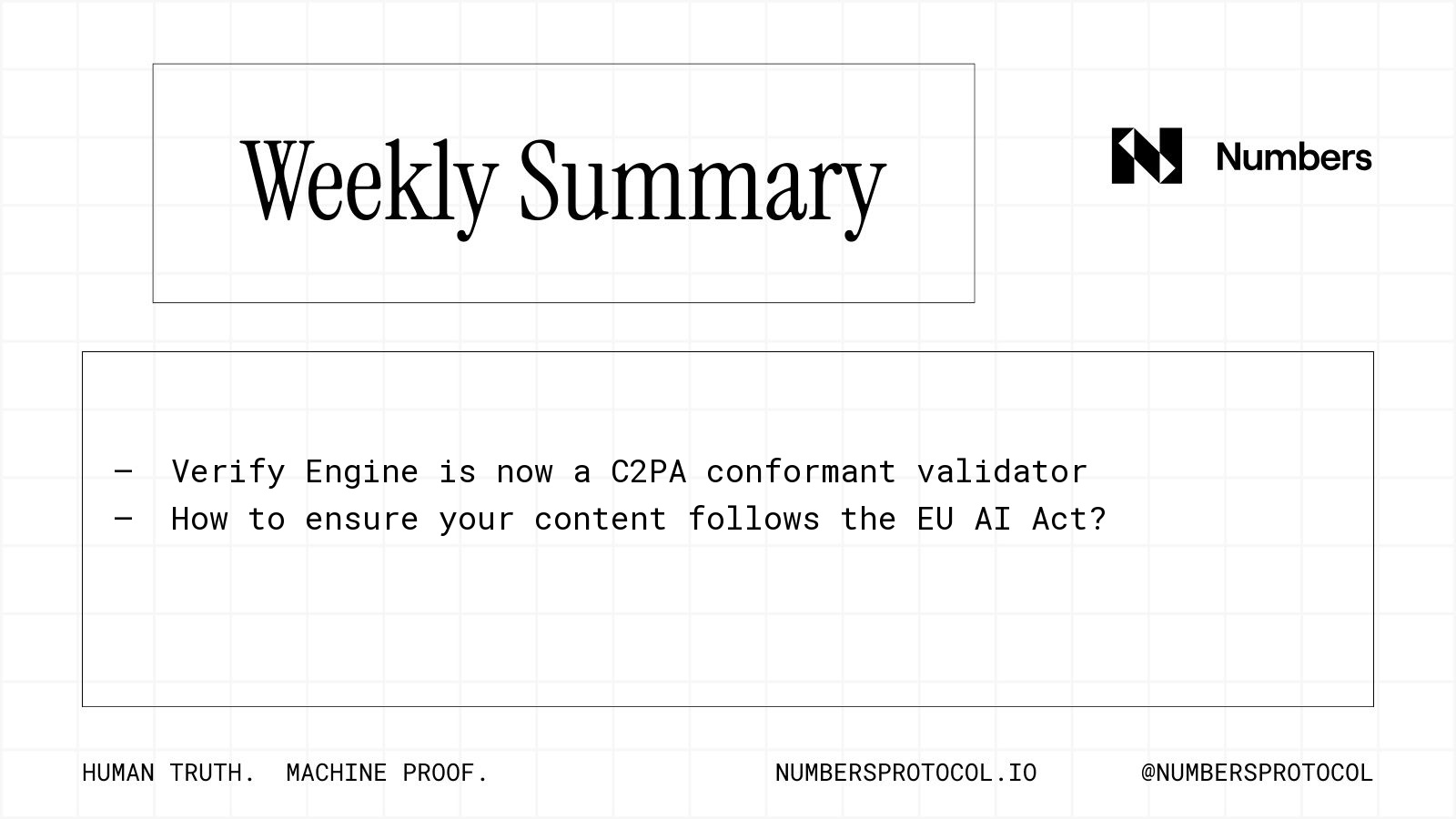
Article 50 of the EU AI Act has applied since 2 August 2026. Depending on the use case, it can require providers and deployers to inform people they are interacting with AI, add machine-readable markings to AI-generated or manipulated content, and disclose certain deepfakes or AI-generated public-interest text. One organization may play different roles across a content chain, so duty ownership needs mapping step by step. Our Article 50 explainer offers a practical workflow test. It is general information, not legal advice.
Numbers Verify Engine is now listed by C2PA as a conformant Validator Product. The designation is technical, but the operational question is simple: does the C2PA record remain valid in the delivered file? C2PA makes provenance portable, and Verify Engine makes that record testable. A validation result, timestamp, and file hash can turn a general assurance into a receipt that another team can inspect.
That distinction matters because content rarely travels untouched. An AI-generated image can be correctly marked at creation, then resized, converted, uploaded to a CMS, downloaded, compressed, or reposted. Testing only the source proves that the first step worked. Testing the exported and public copies shows whether the transparency evidence survived the actual workflow.
The same principle applies when work crosses organizational boundaries. An agency may use AI, approve a final version, and hand it to a client for publication. The asset should stay connected to the system used, the reviewed version, the approval decision, the transparency decision, and the people responsible for each step. Capture SDK can register the asset as it enters the workflow, while NID gives it a persistent reference after it leaves the original system.
Together, these pieces make provenance practical: Capture records the asset, NID keeps it referenceable, C2PA carries interoperable context, and Verify Engine checks what arrived. Human truth. Machine proof. becomes stronger when every handoff leaves evidence instead of asking the next team to reconstruct history from folders and messages.
As usual at weekends, the team will respond a little more slowly while taking some rest. Our moderators will keep supporting you, and the team will be well prepared for the new week.
Onward,
Steffen