23 March 2026
Weekly Summary Letter
2026/03/23 Weekly Summary Letter
Hey NUMBERS community,
This week the question we kept returning to was a simple one: what does it take for provenance to stop being a concept and start being something you can actually build on? The answer, as it turns out, is an address.
The NID is that address. Every asset registered on Numbers Protocol receives a permanent on-chain identifier that makes its full provenance record queryable with a single API call: creator identity, proof hash, ownership history, C2PA credentials. The web has always been good at indexing content. What it has never had is an index for origin. NID is that index, and this week we went deep into how developers can wire it directly into their workflows, writing provenance logic that runs autonomously rather than relying on trust assumptions.
What makes infrastructure worth building is what people do with it. HakimLh973 took the provenance layer somewhere nobody mapped out in advance: a concept called Meme DNA, designed to trace the full evolutionary lineage of internet memes. Every meme gets an origin record via Capture SDK, and every remix references its parent. Over time you get a complete lineage tree, not just a verification snapshot but a living record of where something came from and what it became. That kind of creative application of open infrastructure is exactly the signal that the foundation is solid.
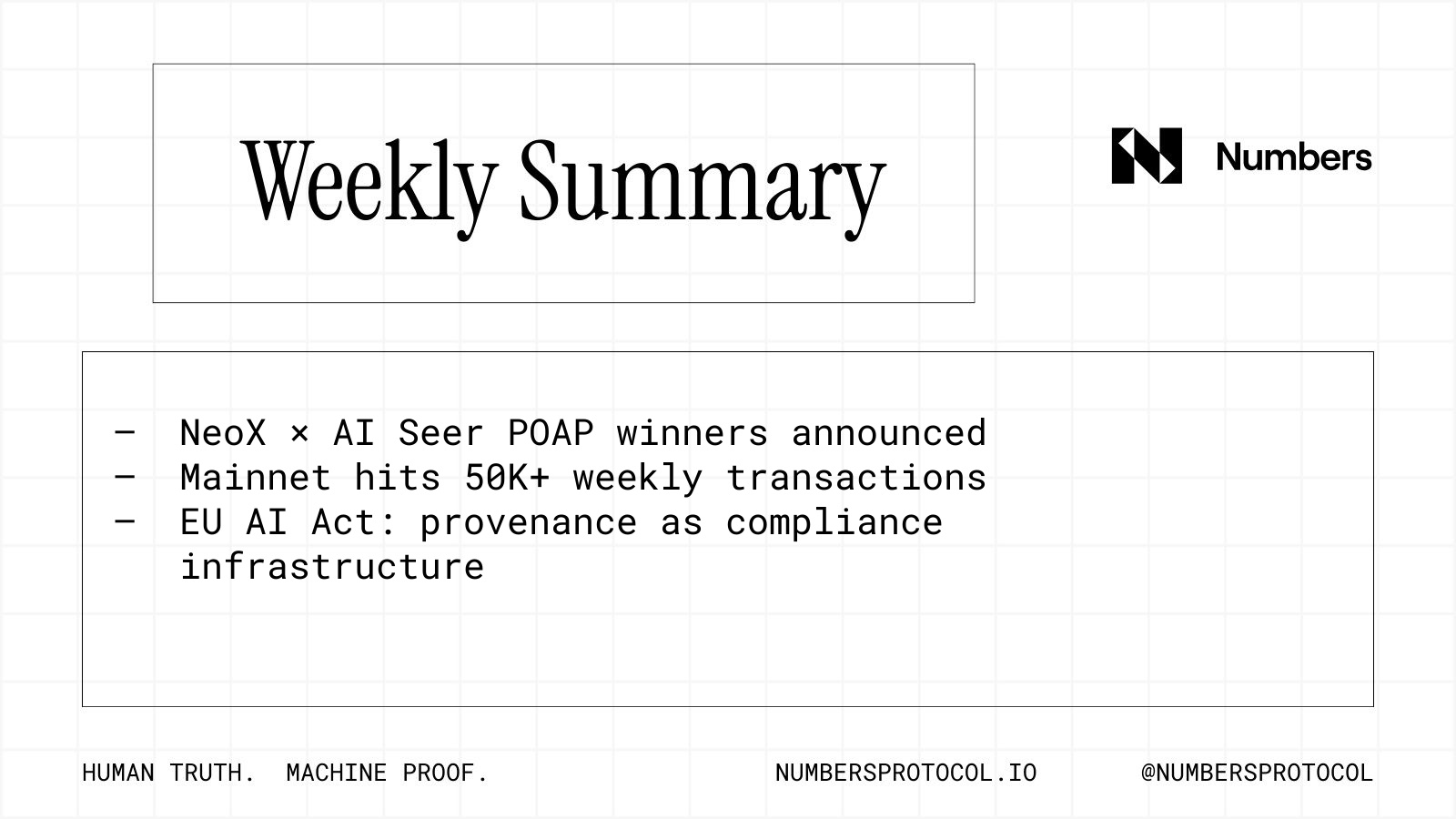
On the community side, the NeoX × AI Seer AMA POAP campaign wrapped up this week, with winners drawn and verified on-chain. Numbers Mainnet crossed 50,000 transactions in a single week, and that number has been holding consistently. Part of that comes from campaigns, but a meaningful and growing share comes from internal operations: every approval, confirmation, and decision the team makes gets anchored on-chain by default. Provenance as infrastructure means the receipts stack regardless of whether a campaign is running.
The broader context is sharpening too. August 2, 2026 is when the EU AI Act's high-risk requirements come into full force. According to appliedAI's research, 40% of enterprise AI systems currently have unclear risk classifications. The documentation regulators will ask for, data lineage, model behavior records, design decision trails, cannot be reconstructed after the fact. Organizations that treated governance as something to add later are running out of runway. The ones building provenance in from the start are not just compliant: they are building systems that can explain themselves.
Onward,
Steffen